The shout rips through the darkness at midnight.
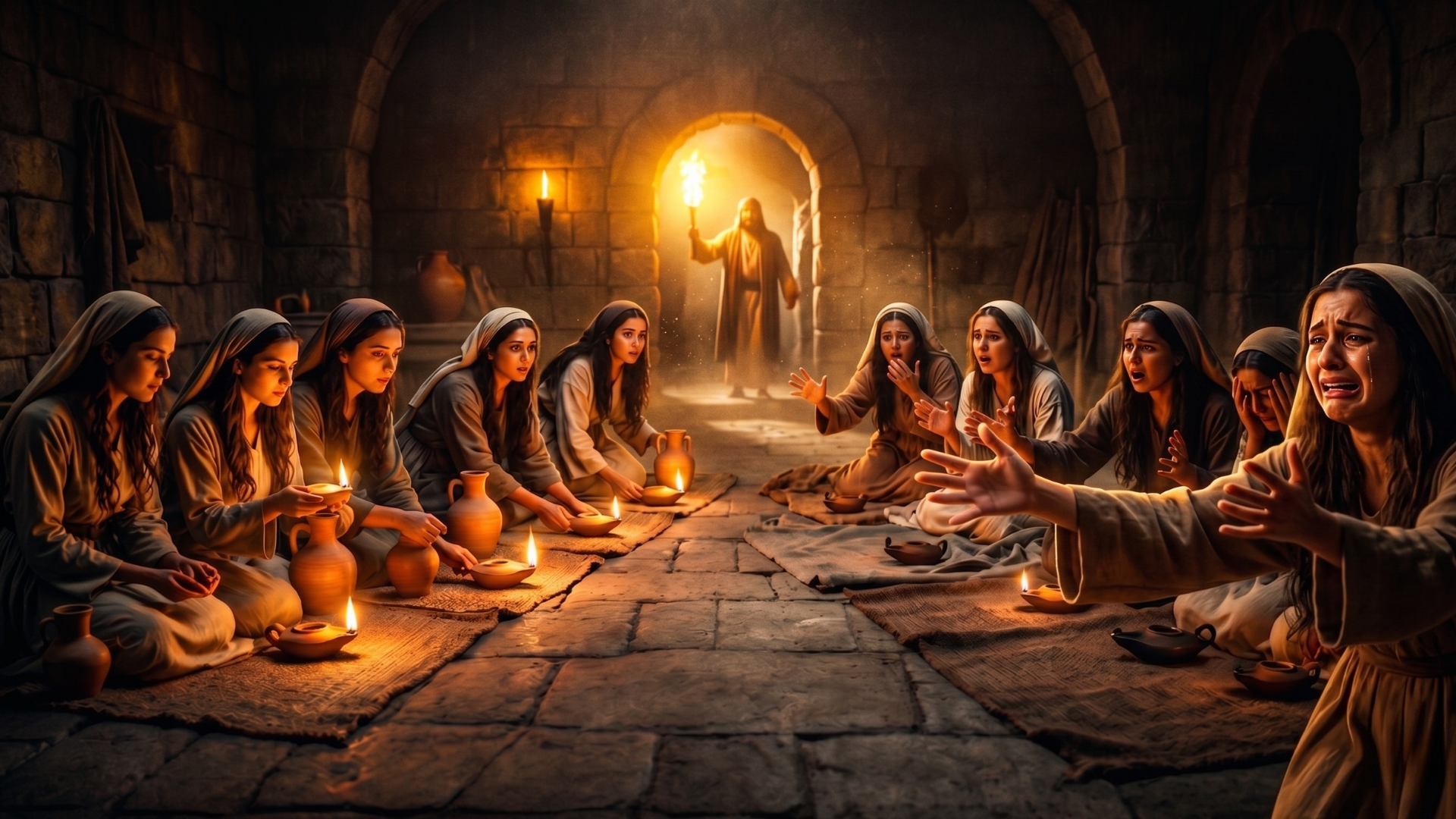
Ten women jolt upright from the roadside where they have been sleeping, hands reaching for clay lamps that have gone cold. Every wick is black. Every flame is out. Every one of them fell asleep waiting for a bridegroom who did not arrive when he was supposed to.
Five of them reach beneath their cloaks and pull out a second container. They pour oil into their lamps, trim the wicks, and the flames catch. Five of them reach for nothing, because there is nothing to reach for.
The five with fire join the procession. The five without fire stand in the dark and watch the light move away from them, toward a door they can hear opening in the distance.
By the time they find oil, the door is no longer open. It is shut. And from the other side, a voice they expected to welcome them delivers five words that bury every assumption they carried into the night: “I do not know you.” (Matthew 25:12, NKJV)
That door does not open again. What separates these two groups is not sincerity, not intention, and not even the fact that both fell asleep. It is a single mechanical difference that could not be corrected at the moment it was exposed.
The Starting Line Where Everyone Looks the Same
Jesus places this parable at a specific point in His teaching for a reason.
It comes in Matthew 25, immediately after the warnings of chapter 24 where Christ has repeated with unmistakable emphasis that no one knows the day or the hour of His return. The parable is not a freestanding story. It is the illustration of what that unknowing does to different kinds of people over time.
“Then the kingdom of heaven shall be likened to ten virgins who took their lamps and went forth to meet the bridegroom.” (Matthew 25:1, NKJV)
The word “then” is a hinge. It connects this story directly to everything Christ has just said about unexpected arrivals, broken timelines, and the danger of assuming you have more time than you do.
And the parable begins with a detail that should unsettle every reader: at the starting line, the two groups are identical.
All ten have lamps. All ten intend to be at the wedding feast. If you were standing on a first-century Judean road watching this procession begin, you could not tell the wise from the foolish. The enthusiasm is the same. The equipment is the same.
The difference is invisible, and it is everything.
“The foolish took their lamps and took no oil with them, but the wise took oil in their vessels with their lamps.” (Matthew 25:3-4, NKJV)
In the first-century Jewish wedding, bridesmaids carried oil lamps to illuminate the bridegroom’s path to the feast. A lamp without reserve oil is a bet that the bridegroom will arrive on your schedule. A vessel of extra oil is an acknowledgment that his schedule might shatter yours.
That is the mechanical difference. Not more faith. Not more sincerity. More oil in a separate container.
Why the Delay Changes Everything
The delay is not a footnote in this parable. It is the engine that drives the entire narrative.
“But while the bridegroom was delayed, they all slumbered and slept.” (Matthew 25:5, NKJV)
All ten fell asleep. The wise and the foolish alike. The text does not condemn the sleeping. It reports it as the natural human consequence of a timeline that has broken down. The body cannot sustain high alert indefinitely. When the expected hour passes and the bridegroom does not come, exhaustion wins.
The danger is not the sleep. The danger is what the delay does to the soul underneath the sleep.
Jesus illustrates this in Matthew 24 with the portrait of a servant who breaks under the weight of waiting: “But if that evil servant says in his heart, ‘My lord is delaying his coming,’ and begins to beat his fellow servants, and to eat and drink with the drunkards, the master of that servant will come on a day when he is not looking for him and at an hour he is not aware of.” (Matthew 24:48-50, NKJV)
The mechanism is precise. The servant perceives the delay. The perception produces a conclusion: the master is not coming soon. The conclusion produces a behavior change. And then the master returns, finding the servant frozen in whatever condition the delay produced.
The delay does not change the master’s arrival. It changes the servant’s posture. That is why the extra oil matters. The oil is not for the moment the bridegroom arrives. It is for the hours between the expected arrival and the actual one. The vessel is the provision for the gap.
The Parable of the Ten Virgins and the Cry That Ends the Waiting
The parable pivots on a single sound.
“And at midnight there was a cry made: ‘Behold, the bridegroom is coming; go out to meet him!’” (Matthew 25:6, NKJV)
Midnight. The darkest, coldest, most disorienting hour to be woken from a dead sleep. The cry does not arrive at dusk when the lamps are still warm. It does not arrive at dawn when light is already breaking. It arrives at the precise moment when human readiness is at its lowest.
All ten virgins rise. All ten trim their lamps. The trimming is the moment of truth, because trimming a wick without oil is trimming dead fiber. Nothing catches. Nothing burns. The lamp stays dark.
“And the foolish said to the wise, ‘Give us some of your oil, for our lamps are going out.’ But the wise answered, saying, ‘No, lest there should not be enough for us and you; but go rather to those who sell, and buy for yourselves.’” (Matthew 25:8-9, NKJV)
The refusal sounds callous to modern ears. But the refusal is not about selfishness. It is about the nature of what the oil represents. The oil in this parable is the accumulated, personal, daily-maintained relationship with God. It is faith built through years of private obedience. It is trust forged in seasons when God was silent and you kept showing up.
You cannot borrow another person’s prayer life at midnight. You cannot pour someone else’s years of faithfulness into your empty vessel in a moment of panic. The wise virgins are stating a law of spiritual reality: this oil is non-transferable.
Word Study: Delayed (Greek, Chronizo / χρονίζω)
The Greek Chronizo (χρονίζω) in Matthew 25:5 means to linger, to take a long time, to delay beyond the expected point. The root is chronos (time), carrying the specific connotation of time stretching past what was anticipated. The bridegroom is not gone. He is coming. But the chronizo stretches the gap between promise and fulfillment until the gap itself becomes the test. The lamp burns through its oil in the delay. Only the vessel sustains the flame through the chronizo.
Christ: The Bridegroom Who Knows What Watching Costs
Christ does not deliver this parable as an observer. He delivers it as the bridegroom.
John 3:29 identifies Him directly: “He who has the bride is the bridegroom; but the friend of the bridegroom, who stands and hears him, rejoices greatly because of the bridegroom’s voice.” (NKJV) Christ is not teaching about someone else’s wedding. He is describing His own return and what He will find when He arrives.
And here is what makes this parable more than a warning. The One who commands “Watch” is the One who knows exactly what watching costs.
In Gethsemane, the night before the cross, Christ asked three disciples to do the very thing this parable demands: stay awake, stay alert, keep the oil burning through the darkest hour.
“Then He came to the disciples and found them sleeping, and said to Peter, ‘What! Could you not watch with Me one hour?’” (Matthew 26:40, NKJV)
They could not. The spirit was willing, but the flesh was weak. And then Christ did what no one else in the garden could do: He kept watching.
He kept the flame burning. When every human lamp around Him went out, He carried the oil alone into the darkest night any soul has ever entered. He brought the full weight of what was coming to the Father: “O My Father, if it is possible, let this cup pass from Me; nevertheless, not as I will, but as You will.” (Matthew 26:39, NKJV)
The bridegroom asking you to watch is not issuing a command from comfort. He watched first. The oil that sustained Him was not self-generated. It flowed from the Father. When this bridegroom returns at midnight, He returns as the One who kept His own lamp burning at the greatest possible cost so that every vessel connected to Him would never run dry.
Word Study: Watch (Greek, Gregoreuo / γρηγορεύω)
The Greek Gregoreuo (γρηγορεύω) in Matthew 25:13 means to stay awake, to be vigilant, to remain alert. It is the opposite of the spiritual sleep that overtakes those who assume they have time. Christ uses the same word in Gethsemane: “Could you not gregoreuo with Me one hour?” The command is not passive anxiety. It is active, costly attentiveness. The bridegroom who tells you to watch is the bridegroom who watched when no one else would.
Three Ways a Lamp Goes Out
The parable names one fatal error: no oil in the vessel. But Scripture reveals three distinct patterns that produce that empty vessel.
The Sprint Flame
This is the person who prepared for a short race and got a marathon. They filled the lamp but never filled the vessel. Their faith was real at the starting line. But they calculated for an arrival that matched their timeline, and when the bridegroom delayed, the oil burned through.
This pattern shows up in the seed on rocky ground in Matthew 13:20-21. The person receives the word with joy, immediately. But there is no root, no reserve beneath the surface. When tribulation rises, the plant withers. The sprint flame burns bright and burns fast.
The Normalized Absence
This is the evil servant of Matthew 24:48. The delay does not extinguish the flame all at once. It convinces the person that the flame does not need tending. The master is not coming soon. The urgency fades. The vessel that should be refilled daily gathers dust. The person does not rebel. They simply stop maintaining the supply because the absence of the bridegroom has started to feel permanent.
This is the most common pattern in long-term faith. A slow evaporation of vigilance that feels like maturity but is actually complacency.
The Decorated Lamp
This is the lamp that looks lit from a distance because someone has wrapped it in bright cloth. The appearance of fire without the reality of it. Church attendance without communion with God. Theological vocabulary without theological obedience. The right answers at the right moments, powered by memory, not by oil.
Jesus addressed this pattern directly in Matthew 7:21-23: “Not everyone who says to Me, ‘Lord, Lord,’ shall enter the kingdom of heaven, but he who does the will of My Father in heaven.” The decorated lamp calls Him Lord. It prophesies in His name. It casts out demons. And the bridegroom says, “I never knew you.” The performance was real. The oil was not.
Three Guardrails for Keeping Oil in the Vessel
Guardrail 1: The Vessel Audit
What you do: Ask: If the bridegroom came tonight, what would He find in my vessel? Identify the specific practices that constitute your oil supply: daily prayer, sustained Scripture engagement, quiet obedience in private. If you cannot name them, the vessel may be empty.
What it defends against: The sprint flame. The assumption that the initial filling is sufficient for the entire wait. This guardrail forces you to confront whether your readiness is current or historical.
Its connection to Christ: Christ maintained His connection to the Father daily, rising before dawn to pray (Mark 1:35), withdrawing to lonely places when the crowds pressed. His oil was not from one filling. It was from a sustained communion that never ran dry.
Guardrail 2: The Midnight Test
What you do: When complacency whispers that the bridegroom is not coming soon, treat the whisper as an alarm. Ask: If the cry came tonight, would I be ready to trim my wick and join the procession? Name the specific area where you have stopped watching because the delay has normalized.
What it defends against: The normalized absence. The evil servant of Matthew 24 did not plan to be caught unprepared. He let the delay rewrite his expectations. The midnight test resets those expectations by placing the arrival back in the present tense.
Its connection to Christ: Christ warned He would come at an hour when He was not expected (Matthew 24:44). The bridegroom does not announce His schedule. He announces His certainty. The midnight test takes that certainty seriously enough to live as though the next hour could be the one.
Guardrail 3: The Recognition Check
What you do: Ask the question the shut door forces: Does the bridegroom know me? Not “Do I know about Him?” but “Does He recognize me as someone who has walked with Him?” Examine whether your relationship with Christ is built on daily, personal communion or on secondhand knowledge.
What it defends against: The decorated lamp. The reply “I do not know you” is not addressed to strangers who never heard of Christ. It is addressed to people who called Him Lord. This guardrail forces the question of intimacy, not information.
Its connection to Christ: The bridegroom’s voice in John 10:27 is recognized by His sheep because they have heard it before: “My sheep hear My voice, and I know them, and they follow Me.” He knows them because they have been in His presence. The oil of daily communion is what makes a face recognizable in the firelight at midnight.
Word Study: Know (Greek, Oida / οἶδα)
The Greek Oida (οἶδα) in Matthew 25:12 means to know by perception, recognition, or intimate acquaintance. The bridegroom does not say “I have never heard of you.” He says “I do not recognize you as someone who belongs here.” The foolish virgins knew His name. They called Him Lord. But oida requires the accumulated history of a relationship. The empty vessel proved that history had never been built. Without it, the face at the door is a stranger’s face, and the door stays shut.
The Promise on the Other Side of the Flame
Go back to the road.
The shout has already split the darkness. The ten women are already on their feet. But this time, watch the five who reach beneath their cloaks and pull out the vessel. Watch the moment the oil hits the lamp and the wick catches and the flame climbs back to life. Watch the relief on their faces as they join the procession, not because they were stronger than the other five, but because somewhere in the weeks before this night, they poured oil into a container they could not see the bottom of, for an hour they could not predict.
That is where you are standing right now. The bridegroom has not yet come. The cry has not yet sounded. The road is still dark, and the vessel is still in your hands.
And here is what the parable does not tell you, but Luke 12 does. When those servants with burning lamps finally reach the door, the master who opens it does something no one in the ancient world would have expected:
“Blessed are those servants whom the master, when he comes, will find watching. Assuredly, I say to you that he will gird himself and have them sit down to eat, and will come and serve them.” (Luke 12:37, NKJV)
He tucks His own robes into His belt. He tells the exhausted servants to sit down. And He serves them the feast.
The shut door is real. The parable does not soften it. But the open door on the other side, the one where the master Himself becomes the servant, is just as real. The watching is not a sentence. It is the qualification for a reward so extravagant it inverts the entire order of the ancient world.
“The Lord is not slack concerning His promise, as some count slackness, but is longsuffering toward us, not willing that any should perish but that all should come to repentance.” (2 Peter 3:9, NKJV)
The delay is not abandonment. The delay is oil you have not yet poured.
Your Next Step and Frequently Asked Questions
Fill the vessel tonight. Not next week. Not when conditions improve. Open the Scripture, get on your knees, and pour oil into the container that will be the only thing between you and darkness when the cry finally comes.
Frequently Asked Questions
1. What is the meaning of the parable of the ten virgins?
The parable of the ten virgins in Matthew 25:1-13 teaches that spiritual readiness for Christ’s return must be personally maintained and cannot be borrowed at the last moment. The oil represents the sustained, daily relationship with God that keeps the flame of faith burning through the delay between the promise and the fulfillment.
2. What does the oil represent in the parable of the ten virgins?
The oil represents the accumulated, non-transferable spiritual reserve built through daily communion with God: prayer, Scripture, obedience, and trust maintained over time. It is not a single decision but a sustained supply that keeps the lamp burning when the bridegroom delays.
3. Why couldn’t the wise virgins share their oil?
The wise virgins could not share because the oil represents personal spiritual readiness, which is non-transferable. You cannot borrow another person’s prayer life, faith history, or years of obedience in a moment of crisis. Each person must maintain their own supply.
4. What does the shut door mean in Matthew 25?
The shut door represents the finality of missed opportunity. Once the bridegroom arrives and the wedding feast begins, the time for preparation is over. Christ uses the same image in Luke 13:25 to reinforce that grace and opportunity have a definitive end point.
5. What does it mean to watch in the parable of the ten virgins?
The Greek word “gregoreuo” in Matthew 25:13 means to stay spiritually awake and vigilant. It is not passive anxiety but active, daily maintenance of your relationship with God. Christ modeled this watching in Gethsemane when He stayed awake while His disciples slept.
The Ten Virgins Readiness Audit (choose at least 2 this week)
Option 1: Read Matthew 25:1-13 slowly. Identify which of the ten virgins most resembles your current spiritual condition. Name what you find without softening it.
Option 2: Do the vessel audit. Name the specific daily practices that constitute your oil supply: prayer, Scripture, private obedience, communion with God. If you struggle to name them, the vessel may need filling.
Option 3: Read Matthew 24:48-51. Identify the specific area of your life where the delay has normalized. Where have you stopped watching because the bridegroom has not yet come?
Option 4: Examine your lamp. Compare the visible expression of your faith against the private reality behind it. Ask: Is the flame real, or is the lamp decorated?
Option 5: Read Luke 12:35-37. Sit with the image of the master serving the servants. Let the promise of what waits on the other side of faithful watching recalibrate your posture from fear to anticipation.
Option 6: Read John 10:27. Ask the recognition question: Does the bridegroom know my voice because I have spent time in His presence, or would I be a stranger at the door?
Option 7: The refill. Identify the one spiritual practice you have let lapse during the delay. Resume it this week. Not as a new program. As oil poured into the vessel before the midnight cry.
The Versatile Christian Co. exists to bring Scripture close enough to touch. The oil Christ described in Matthew 25 is not a theological concept for the classroom. It is a supply for the vessel, and the vessel is in your hands tonight.
“Blessed are those servants whom the master, when he comes, will find watching. Assuredly, I say to you that he will gird himself and have them sit down to eat, and will come and serve them.” (Luke 12:37, NKJV)