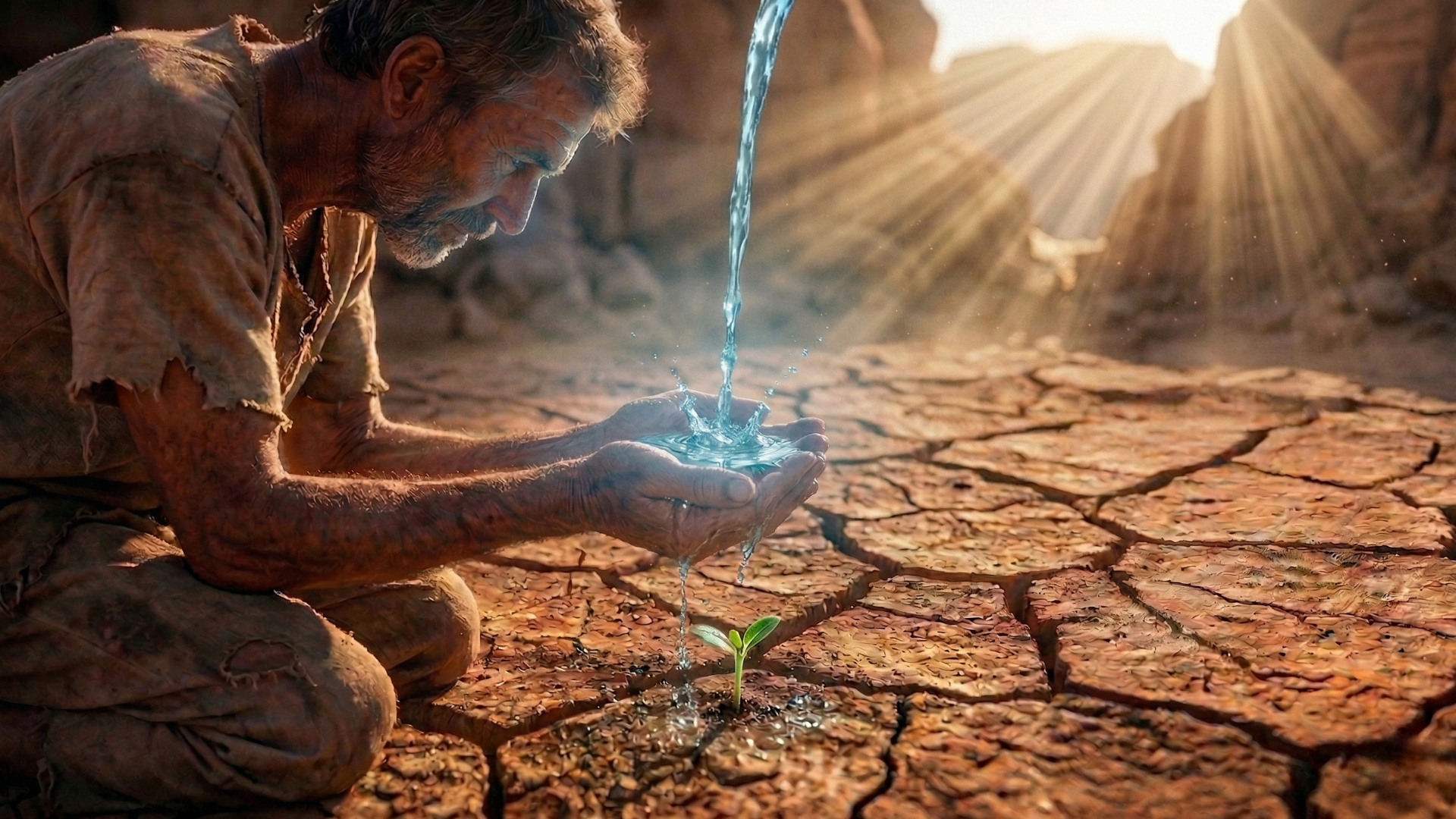
You already know this feeling.
You worked for it. Planned it. Carved it out of solid rock with everything you had. And for a season it held. You felt full.
Then you reached for it again and found only dry earth and sediment.
It happens with careers. With relationships. With achievements that were supposed to finally be enough. The tank fills, the satisfaction leaks, and you are standing in the same spot where you once felt secure, looking at dry ground and wondering what happened.
This is not a productivity problem. The prophet Jeremiah diagnosed it twenty-seven centuries ago, and his diagnosis has not aged a single day.
You are building the wrong water supply.
The Cistern Indictment: What God Called Two Evils
God brings a legal charge against His people in Jeremiah 2:13. Not for violence. Not for idolatry. For a water management decision.
“For My people have committed two evils: They have forsaken Me, the fountain of living waters, and hewn themselves cisterns, broken cisterns that can hold no water.”
The word cistern slides past most modern readers without landing. That is a problem, because the image is the entire argument.
A cistern in the ancient Near East was not a container you purchased. It was a massive underground tank carved by hand into solid limestone bedrock. Israel had no Nile. It depended on seasonal rain. If your land held no natural spring, your option was a pickaxe against solid rock for months, sometimes years, until you had excavated a tank deep enough to hold a family’s water supply. Then you plastered every interior surface to seal the porous stone against leakage. Then you waited for rain.
God stands beside that exhausted labor and says: I was right here.
He describes Himself as a fountain. Not a reservoir. Not a storage system. The Hebrew word implies an artesian spring, water pushing up through bedrock under its own pressure, requiring nothing from you except willingness to receive.
The people looked at the fountain and chose the pickaxe. The reason is one word: control. A spring flows on its own schedule. You cannot measure it, manage it, or own it. A cistern is yours. You built it. You know exactly what is in it.
We would rather exhaust ourselves building something we control than trust something we cannot.
Then God delivers the second charge: the cisterns are broken.
Limestone shifts. Plaster cracks. The tank that took months to carve fills in the rainy season and drains silently through hairline fractures before the dry season arrives. You reach for it when you need it most and find warm sludge at the bottom.
This is the most precise description of human striving ever written. You hew the career. You plaster the relationship. It fills. Something cracks. By the time you reach back for the satisfaction, it is gone.
Not diminished. Gone.
Word Study: Fountain (Hebrew, Maqor / מָקוֹר)
The Hebrew Maqor (מָקוֹר) means a spring, an eye of water bursting from the earth under its own pressure. It does not wait to be pumped. It requires no maintenance. God chose this word to describe Himself. He is not a static reservoir you draw from until it drops. He is a source that flows independently of every drought, every season, and every human effort to manage it. Forsaking Maqor for a cistern is not a reasonable alternative. It is trading a living spring for a cracked hole in the ground.
Jacob’s Well and the Architecture of Thirst
The woman at Jacob’s Well did not know she was going to meet the source of all living water that morning. She knew the water was a hundred feet down and she wanted no conversation.
John 4 places her at the well at noon. Most women came at dawn. She came alone, in the heat, to avoid the social weight of the other women. She had had five husbands and was living with a man who was not her husband. She was a woman who knew everything about things that do not satisfy.
Jesus asks her for water. Then He reframes the entire transaction.
“If you knew the gift of God, and who it is who says to you, ‘Give Me a drink,’ you would have asked Him, and He would have given you living water.” (John 4:10, NKJV)
She heard the words living water and thought of logistics. In the first century, the phrase Mayim Chayim simply meant running water, water from a stream or spring, water that moved and was therefore fresh. She assumed He knew of a hidden creek nearby. She was thinking plumbing while He was rewriting the architecture of the soul.
He pointed to the well. Jacob’s well. A hundred feet deep, historically reliable, the well their ancestor dug. And He said:
“Whoever drinks of this water will thirst again.” (John 4:13, NKJV)
This is the universal law underneath every broken cistern. The satisfaction always ends. The career plateaus. The relationship normalizes. The achievement joins the list of prior achievements, each of which felt final, none of which were. Jacob’s Well is not a failure. It is simply a well. Every human source of satisfaction requires constant return and cannot end the cycle.
Then He made the only claim no water source has ever made:
“But whoever drinks of the water that I shall give him will never thirst. But the water that I shall give him will become in him a fountain of water springing up into everlasting life.” (John 4:14, NKJV)
The mechanism is in that final sentence. This is not a promise of one permanent satisfaction large enough to cover all future need. That would simply be a very large cistern. The promise is structural. The source moves inside. You are not going to a well anymore. The well comes to you. It becomes in you a fountain, an artesian spring pressing upward continuously, independent of surface conditions.
Her problem was not the five husbands. It was that every source she had ever drawn from was outside her, requiring the walk, the bucket, and still leaving her thirsty by morning. What Jesus offered was the end of that architecture. Not a better well. A spring inside.
Word Study: Springing Up (Greek, Hallomenos / ἁλλόμενος)
The Greek Hallomenos (ἁλλόμενος), translated “springing up” in John 4:14, is the language of continuous, forceful movement. The same root appears in Acts 3:8 for the lame man who leaped to his feet after being healed. Not a still pool. Not a passive reservoir. Something that cannot be contained, moving upward against gravity because the pressure behind it exceeds the resistance above it. The living water does not pool. It leaps. It does not wait to be drawn. It rises.
Christ: The Fountain Poured Out
The Feast of Tabernacles was the most dramatic liturgical event in the Jewish calendar. Each morning for seven days, the High Priest led a procession to the Pool of Siloam, filled a golden pitcher, carried it back to the Temple Mount through crowds of thousands with trumpets blowing, and poured it on the altar. The people prayed for rain. It was a national cry for water, enacted publicly, building in intensity until the final great day.
On that day, Jesus stood and shouted over the ceremony.
“If anyone thirsts, let him come to Me and drink.” (John 7:37, NKJV)
The priest was pouring the water. Jesus was redirecting the entire feast. The golden pitcher had always pointed to something. He announced that the thing it pointed to was standing in the crowd.
Then He expanded the John 4 promise outward:
“He who believes in Me, as the Scripture has said, out of his heart will flow rivers of living water.” (John 7:38, NKJV)
In John 4, the living water becomes a fountain inside you. In John 7, it becomes rivers flowing out of you. In Samaria the promise addressed personal thirst. In Jerusalem it addressed communal need. The internal spring does not stop at the edge of you. It overflows into every life around you.
John does not leave this as metaphor. Verse 39 names exactly what the living water is:
“But this He spoke concerning the Spirit, whom those believing in Him would receive; for the Holy Spirit was not yet given, because Jesus was not yet glorified.” (John 7:39, NKJV)
The living water is the Holy Spirit. The internal fountain is the actual presence of God taking up residence inside the human heart. This is where the arc from Jeremiah closes. God said they had forsaken Him, the fountain. The remedy is the fountain returning, not as an external spring you travel to, but as an indwelling presence you carry.
Christ did not deliver this promise from a place of ease. He stood at the feast knowing the cross was weeks away. He went to Gethsemane with a soul He described as “exceedingly sorrowful, even to death” (Matthew 26:38, NKJV), brought that weight fully to the Father, and anchored it in submission. The One who offers the fountain already drank the cup that makes the fountain possible. He knows the cost of trusting the Source when every instinct reaches for the pickaxe.
Word Study: Glorified (Greek, Edoxasthe / ἐδοξάσθη)
The Greek Edoxasthe (ἐδοξάσθη), translated “glorified” in John 7:39, is the aorist passive of doxazo, to honor or exalt. In John’s Gospel, the cross is never simply death. It is the moment of Christ’s ultimate exaltation and the event that opens the pathway for the Spirit. The living water was unavailable until Calvary was complete. Every internal fountain in every believer’s heart flows from that one source event.
Three Cisterns Believers Keep Building
If the fountain has been installed, why are so many believers still thirsty? Because the habits of a cistern-builder are deeply grooved, and the enemy knows exactly which pickaxe fits your hand.
The Productivity Cistern
The belief that spiritual supply can be managed through output. Enough chapters, enough minutes, enough service hours, and the tank fills. The moment peace evaporates, you search for the discipline you skipped. This turns the gift into wages. The living water rises by the Spirit’s own pressure, not by the force of your religious performance.
The Validation Cistern
The unspoken agreement that your spiritual fullness will track your visible fruitfulness. Ministry results up, you feel full. Results flat, you reach for the pickaxe of more effort, more output. The fountain does not fluctuate with your metrics. Rivers flowing out of you are the Spirit’s work. Your job is not to manufacture the flow. It is to stay connected to the Source.
The Familiar Cistern
The broken cistern you built is still there, still carrying the old watermarks from when it used to hold something. Career, approval, the one relationship you keep returning to. You know the bottom is cracked. You have stood in the disappointment before. But it is familiar, and the spring is invisible, and we trust what our hands have made even when it costs us everything.
Three Guardrails for Staying at the Spring
Guardrail 1: The Thirst Acknowledgment
What you do: When spiritual dryness arrives, name it before reaching for a tool. Ask the central diagnostic: where is the pickaxe in my hand right now? What am I trying to hew that I have been asked to receive?
What it defends against: The automatic pivot to religious productivity when supply feels low. A cistern-builder’s first reflex is to dig harder. This guardrail stops that reflex before it becomes a six-month project.
Its connection to Christ: Jesus said, “If you knew the gift of God, you would have asked.” The barrier to living water is almost never access. It is recognition. You cannot ask for what you have not first acknowledged you need.
Guardrail 2: The Ask Before the Effort
What you do: Before any spiritual effort aimed at filling the tank, pray the source-level request: Lord, I am thirsty. You are the fountain. I am asking. Make the ask structurally prior to the work.
What it defends against: The inversion that places human effort before divine supply. Cisterns require effort first, water second. The spring requires trust first, water continuously. Reordering the sequence reorders the architecture.
Its connection to Christ: Jesus did not say, “Whoever has prepared most, come and receive.” He said, “If anyone thirsts, let him come to Me and drink.” The invitation opens on thirst and closes on Him. Nothing in between is the applicant’s contribution.
Guardrail 3: The Overflow Check
What you do: Regularly audit whether the water in your life is flowing inward only or outward as well. John 7:38 promises rivers, not a private reserve. Ask who around you is being watered by what flows through you.
What it defends against: The privatization of the gift. The moment you begin protecting the flow rather than releasing it, you have built walls around a spring. Walls around a spring produce a cistern.
Its connection to Christ: Jesus announced the living water at a national festival, in the middle of a collective ceremony, to a crowd crying out together. The Spirit’s design was never personal only. A river is not for the riverbed. It is for everything downstream.
The Fountain Needs No Help From You
There is a specific exhaustion that comes not from hard work but from the wrong work. You feel it standing next to the dry tank you built with everything you had, wondering if you should just dig deeper.
The answer Jeremiah delivers, confirmed in John, is that the digging was the problem. Not the depth. Not the technique. The entire project was the wrong response to the right thirst.
The fountain does not need your help. The Holy Spirit does not flow more freely when your performance record is stronger. He was given, as John 7:39 records, to those who believe. That giving is complete. The water is already pressing upward from inside you.
Isaiah 44:3 places the promise plainly: “For I will pour water on him who is thirsty, and floods on the dry ground; I will pour My Spirit on your offspring.” The condition is not readiness. It is thirst. The state that feels like disqualification is the very thing that opens the supply.
Drop the pickaxe. The fountain is already here.
Your Next Step and Frequently Asked Questions
One question sits underneath everything this article covers: where are your hands right now? The fountain requires no construction. It requires recognition, thirst, and the willingness to ask.
Frequently Asked Questions
1. What is living water in the Bible?
John 7:39 identifies it directly as the Holy Spirit. In the first century, “living water” physically meant running water from a spring or stream, as opposed to stagnant cistern water. Jesus took the physical image and named the reality: the one source of spiritual supply that flows continuously and cannot run dry.
2. What does Jeremiah 2:13 mean by “broken cisterns”?
Every human-built substitute for God’s presence. Cisterns required brutal labor to carve from limestone but developed hairline cracks that drained them silently. The broken cistern is any system of self-supply you have worked hard to build, that fills for a season and then empties, leaving you thirsty exactly when you need it most.
3. How can Jesus promise we will “never thirst” when believers still feel spiritual dryness?
The promise is not that the need for God disappears. It is that the source becomes internal and continuous. Spiritual dryness after salvation is almost always a symptom of returning to cisterns, not evidence that the fountain has failed.
4. Who is the living water?
John 7:39 names Him: the Holy Spirit. Not a feeling or a discipline. The actual Third Person of the Trinity taking up permanent residence inside the believer, pressing upward continuously as a fountain springing up into everlasting life.
The Living Water Audit (choose at least 2 this week)
• Option 1: Read Jeremiah 2:13. Name your current cistern plainly. Write what you have invested in it and what it has actually returned.
• Option 2: Read John 4:1–26. Track the woman’s responses as the conversation moves from logistics to recognition. Note where you are in the same progression.
• Option 3: Pray only the ask from John 4:10. No outcomes. No requests. Just: “Lord, I am thirsty. You are the fountain. I am asking.” Stop there.
• Option 4: Read John 7:37–39. Write the sequence: thirst, come, drink. Then write the name of the cistern you have been returning to instead of completing it.
• Option 5: Do the overflow audit. Name three people downstream of your spiritual life. Is anything flowing toward them, or has the water gone entirely to personal maintenance?
• Option 6: Read Isaiah 44:3 and Isaiah 55:1. Note the only condition God attaches to His offer and what that condition requires of you.
• Option 7: Sit with John 4:14 in both NKJV and KJV. Ask the Spirit to make the internal fountain more real than the cistern you can see and measure. This is not a discipline. It is the ask.
At The Versatile Christian Co., we are servants to the Word. Our mission is to bring the text close enough to touch, so that the fountain Jesus described in John 4 is not theology you hold at arm’s length, but water you drink today.
Check out the Study Guide and Workbook for a deeper dive into true spiritual hydration.
“If anyone thirsts, let him come to Me and drink. He who believes in Me, as the Scripture has said, out of his heart will flow rivers of living water.” (John 7:37–38, NKJV)