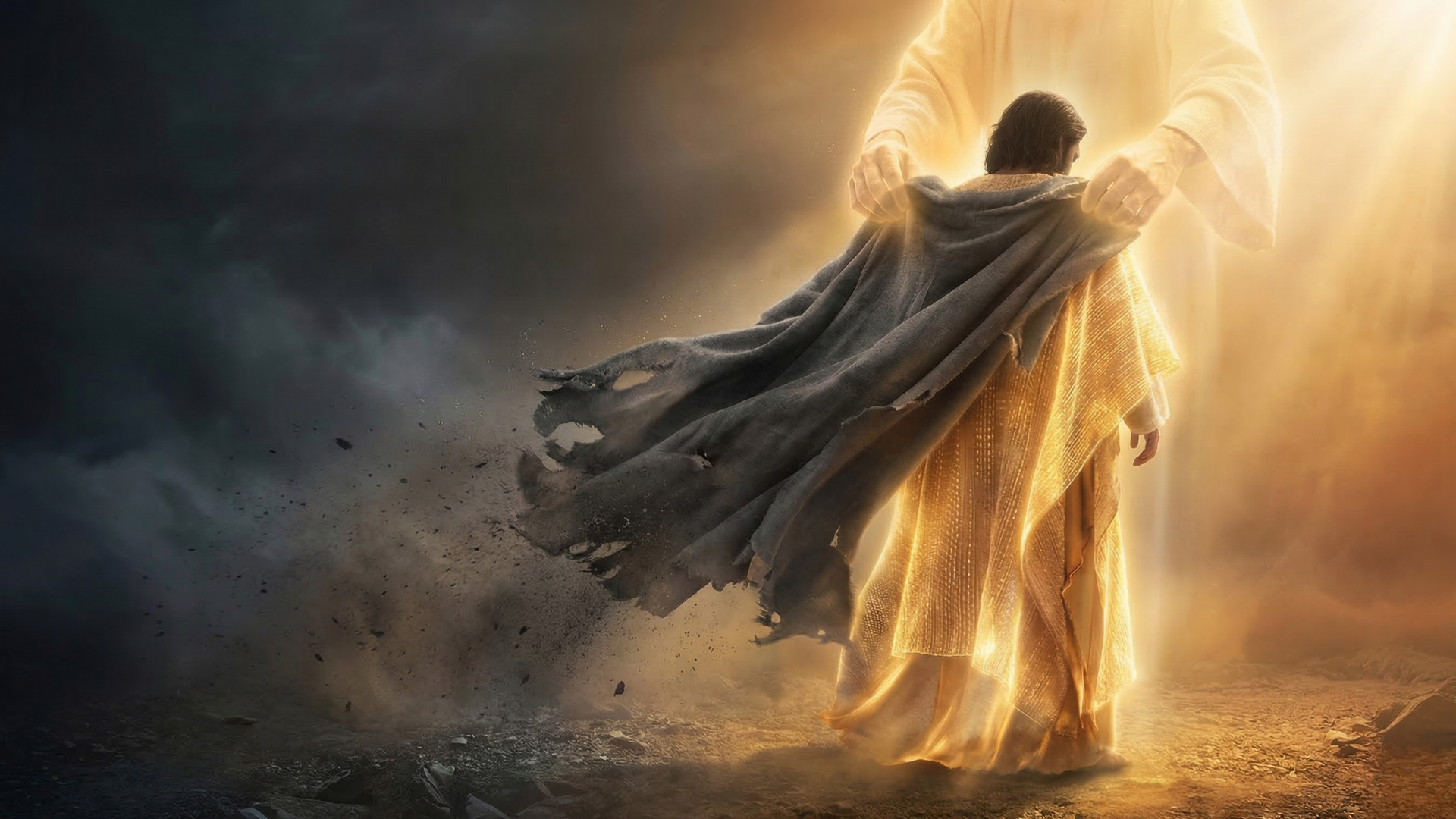
You already know something is wrong.
Maybe you have been attending church for years and still feel hollow on Sunday afternoon. Maybe you raised your hand at an altar call, but the peace you were promised never fully arrived. Maybe you are watching someone you love walk a road you know leads nowhere, and you feel powerless to say anything that would actually reach them.
Or maybe the fear is quieter than that. It is just a low hum underneath everything. A question you will not quite let yourself finish: What if I am doing this wrong?
That question is not a sign of weak faith. It is a sign of an honest heart. And it is exactly the question Christ addresses at the end of the Sermon on the Mount.
He does not answer it gently. He answers it precisely. That precision is its own form of mercy.
The Inspection That Cannot Be Faked
A structural inspector is indifferent to aesthetics. While the home buyer focuses on the granite countertops or the wraparound porch, the inspector descends into the basement with a flashlight. He is searching for stress fractures and rot in the foundational beams. His only question is not how the house looks in the sunlight, but how it will perform when the storm arrives.
In the Sermon on the Mount, Christ operates as that Inspector. He concludes not with a suggestion about exterior improvements, but with a warning about what is underneath. The parable of the two builders in Matthew 7:24–27 is not a motivational analogy. It is a load-bearing diagnostic. He is telling you that the storm is coming, that every foundation will be tested, and that the only variable that matters is what you built on before it arrives.
The foundation Christ is examining is not your attendance record or your vocabulary. It is obedience. The wise builder is defined in one phrase: the one who “hears these sayings of Mine, and does them.” (Matthew 7:24) The foolish builder heard the same words. He simply did not build on them.
That distinction is the structural difference the rest of this article is built on.
Why the Wide Gate Is So Convincing
The danger of the broad way is not that it looks dangerous. It is that it looks reasonable.
Matthew 7:13–14 presents the reality plainly: “Wide is the gate and broad is the way that leads to destruction, and there are many who go in by it. Because narrow is the gate and difficult is the way which leads to life, and there are few who find it.” The wide gate is popular precisely because it requires nothing be surrendered at the door.
The narrow gate operates on different terms entirely.
Word Study: Strait (Greek: Stenos)
The Greek word Stenos (στενός), translated “strait” or “narrow,” describes a tight, restricted passage. Think of a mountain gorge so constricted that the traveler must shed all unnecessary weight to pass through. It implies pressure. Entering the Strait Gate is structurally impossible for the person who refuses to let go of their own sovereignty.
This is not a gate that can be widened by effort or enthusiasm. It is narrow by design. What it strips away at the entrance is precisely what the broad gate welcomes in: self-authorship, the right to define your own terms, the comfort of a faith that costs nothing and demands nothing.
That shedding is not a punishment. It is the architecture of the way itself.
The Fruit Test Has No Override
Christ does not leave the narrow gate as an abstract concept. He immediately provides a diagnostic tool for examining both false teachers and your own spiritual state.
“You will know them by their fruits.” (Matthew 7:16)
This test is organic, not institutional. It does not ask about your theological pedigree or your public record. It looks at what your life is actually producing. A corrupt tree is biologically incapable of producing good fruit. The output reveals the nature of the root system underneath.
The warning about wolves in sheep’s clothing in Matthew 7:15 applies outward, but Christ uses it to drive the inspection inward by Matthew 7:22. The most unsettling passage in the entire Sermon is what follows. “Many will say to Me in that day, ‘Lord, Lord, have we not prophesied in Your name, cast out demons in Your name, and done many wonders in Your name?’ And then I will declare to them, ‘I never knew you.’” (Matthew 7:22–23)
These are not people who rejected Christ. These are people who believed they were serving Him. They had the vocabulary. They had the resume. What they lacked was a foundation built on obedience to the Father’s Will rather than their own spiritual performance.
The fruit test cannot be bypassed by impressive activity. The Inspector is not moved by the countertops.
Word Study: Difficult (Greek: Thlibo)
The Greek word translated “difficult” in Matthew 7:14 is thlibo (θλίβω), meaning to press or compress. The narrow way presses you. It does not leave room for self-sovereignty to expand unchecked. This compression is not punishment. It is produced by an accurate view of who God is relative to who you are. Proverbs 9:10 calls that view the beginning of wisdom: “The fear of the Lord is the beginning of wisdom.” You cannot walk the narrow way without it, because the narrow way begins where self-sufficiency ends.
The Bedrock Is a Person, Not a Program
The wise builder does not commit to trying harder. He builds on something that does not shift.
Christ defines the foundation clearly. He does not say “build on principles.” He says build on these sayings of Mine, and do them. The foundation is not a system. It is the person of Christ and the authority of His words executed in daily life.
Paul makes this explicit in 1 Corinthians 3:11: “For no other foundation can anyone lay than that which is laid, which is Jesus Christ.” Building on that Person means His words become the load-bearing structure of how you actually live, not just what you believe when asked.
Word Study: Cross (Greek: Stauros)
Luke 9:23 is the construction command that follows the foundation choice. “If anyone desires to come after Me, let him deny himself, and take up his cross daily, and follow Me.” To a first-century listener, the Stauros (σταυρός) was not a metaphor for inconvenience. It was an instrument of state execution. Taking it up meant walking toward your own death.
This is the daily work of the foundation. The self’s claim to govern itself is brought under the authority of Christ’s words. Not once, at conversion. Daily.
The weight of that command changes when you consider who is giving it.
The One asking you to take up your cross already carried His own. He did not issue this command from a position of safety. He walked the path first, at its most costly end, in the full knowledge of what it would require. When He says follow Me, it is not the order of a general who observes from a distance. It is the invitation of a Shepherd who walks into the valley ahead of you, who has already borne the stones you will stumble over, who knows the cost of every step He is asking you to take.
The cross is not only the requirement of discipleship. It is the proof that Christ took seriously the same death He asks you to die.
Three Ways the Broad Foundation Disguises Itself
The broad way does not announce itself. It presents as reasonable and spiritually sufficient. Here are its three most common forms inside the church.
The Public Label Error
This is the belief that a visible profession equals an internal reality. It produces a faith that exists primarily in public: in church attendance, in the vocabulary of Sunday conversation. The Inspector does not examine the label. He examines what is underneath it. A faith coherent in public but ungoverned in private is paint over a crumbling frame.
The Comfortable Middle
Revelation 3:16 describes the Laodicean church as neither cold nor hot, and Christ’s response is visceral: “I will vomit you out of My mouth.” The Laodiceans were not hostile to Christ. They were indifferent to the cost of full surrender. They claimed sufficiency while remaining spiritually bankrupt. A faith that has been calibrated for comfort rather than obedience is a foundation that looks adequate in dry weather and fails in the flood.
The Faith Without a Pulse
James 2:26 provides a diagnostic with no ambiguity: “For as the body without the spirit is dead, so faith without works is dead also.” A corpse has the shape of a person. It has every visible feature of life. What it lacks is breath. A faith that holds all the correct doctrinal positions but produces no change in how a person actually lives is not weak faith. It is dead faith. The foundation is the obedience, not the vocabulary.
Three Practices That Build on Bedrock
Building on the rock is not a decision made once. It is a daily construction process. Here are three guardrails that separate the wise builder from the one who only hears.
Guardrail 1: The Daily Surrender
What you do: Each morning, identify one specific area where your own judgment is competing with Christ’s instruction, and yield it to the authority of His Word before the day begins.
What it defends against: The creep of self-sovereignty that gradually shifts the foundation from Christ’s words to your own preferences. The broad way is most dangerous when it is entered one small compromise at a time.
Its connection to Christ: Jesus defines the wise builder in a single phrase: “hears these sayings of Mine, and does them.” (Matthew 7:24) The daily surrender is the daily execution of that definition. It is not a feeling. It is a choice made concrete.
Guardrail 2: The Fruit Audit
What you do: Regularly measure the output of your life against the standard Christ described, not against the standard of others around you or the culture at large. Look at your reactions under pressure, your use of time, your treatment of people who can do nothing for you.
What it defends against: The “Lord, Lord” deception of Matthew 7:22, where spiritual activity substitutes for obedience to the Father’s will. Impressive performance inside the church can mask a foundation that has never been examined.
Its connection to Christ: “A good tree cannot bear bad fruit, nor can a bad tree bear good fruit.” (Matthew 7:18) The fruit is not the goal. The fruit is the evidence of what the root system is actually built on. Christ is the root. The audit reveals whether you are genuinely grafted in or simply adjacent to something that looks like the vine.
Guardrail 3: The Obedience Dig
What you do: Move past the hearing of the Word into the execution of it. When Scripture commands forgiveness, execute the act of forgiveness. When it commands generosity, give. When it commands silence, be still. The distance between hearing and doing is exactly where sand foundations are built.
What it defends against: The storm of Matthew 7:27, which falls on both houses equally. It does not test your knowledge of the blueprint. It tests what you built. Hearing without doing produces a faith that collapses under the first serious weight it carries.
Its connection to Christ: Palingenesia (παλιγγενεσία) in Titus 3:5 means a complete re-birth from the inside out. You cannot try harder into a new foundation. But the Holy Spirit’s work of “regeneration” produces a person genuinely capable of doing what the Word commands, because the nature has been changed, not just the behavior managed.
The Inspector Already Knows What Is in the Basement
If you started reading this with that quiet hum of fear underneath everything, the worry that you have been building on the wrong foundation, or the grief of watching years pass while the deep change you expected never came, then hear this clearly.
Christ already knows what you found in the basement. He was there before you arrived with the flashlight.
The same Jesus who issued the warning about the two gates is the One who left the ninety-nine to find the one lost sheep. He did not stay in the fold and explain to the missing lamb what it should have done differently. He went into the wilderness, put it on His shoulders, and carried it home. That is the character of the Inspector issuing this audit.
If the inspection has exposed cracks, do not let the weight of it lead you to despair. The intensity of the examination is proof of the Architect’s love. He does not show you the fracture lines to condemn you. He shows them because He is standing there with the materials to rebuild.
“As many as I love, I rebuke and chasten. Therefore be zealous and repent.” (Revelation 3:19)
The door to restoration is open. The work of digging to the bedrock can begin today. Not in your own strength. Supported by the same grace that found you before you knew you were lost, carried by the same Shepherd who already knows the weight of the cross He is asking you to take up, and anchored in the same Person who is the only foundation that does not shift when the water rises.
He is not asking you to build something He has not already stood on.
Your Next Step and Frequently Asked Questions
Everything in this article points toward one decision: stop treating discipleship as a destination you arrive at and start treating it as a foundation you build on, one act of obedience at a time. Open Matthew 5 through 7. Read the whole Sermon. Read it as a construction manual, not an inspiration piece.
Frequently Asked Questions
1. Does “strait gate” mean a straight line in the Bible?
No. “Strait” (s-t-r-a-i-t) means narrow or restricted, not geometrically straight. It refers to a passage so constricted that entry requires shedding what cannot fit through.
2. Can I be saved by my good works?
No. Ephesians 2:8–9 is precise: “For by grace you have been saved through faith, and that not of yourselves; it is the gift of God, not of works, lest anyone should boast.” Verse 10 clarifies the order: we are saved for good works, not by them. Obedience is the evidence of what was built.
3. What does “I never knew you” mean in Matthew 7:23?
It describes people who had a spiritual resume but lacked obedience to the Father’s will. They were active in His name but not submitted to His authority. The word “knew” here is ginosko (γινώσκω), a relational knowing, not intellectual awareness.
4. Is taking up your cross a one-time event?
No. Luke 9:23 adds the word “daily.” The cross is not a single crisis decision. It is the ongoing practice of placing self-will under the authority of Christ every day.
5. What is the “fruit” Jesus refers to in Matthew 7?
Fruit is the visible output of an internal nature. It includes the quality of your relationships, how you behave when no one is watching, where your time and resources go, and whether your conduct matches your confession.
6. Why is lukewarmness treated so severely in Revelation 3?
Because lukewarmness is not the absence of faith. It is faith calibrated for comfort rather than surrender. The Laodiceans believed they were spiritually adequate while being, in Christ’s own diagnosis, “wretched, miserable, poor, blind, and naked.” (Revelation 3:17) The severity of the response matches the depth of the self-deception.
7. What is the difference between a sand foundation and a rock foundation in the parable?
Both builders heard the same Sermon. The difference is entirely in what they did with it. The rock foundation is built through obedience to Christ’s words. The sand foundation is built through hearing them and stopping there.
8. What does regeneration mean and how does it connect to discipleship?
Regeneration, from the Greek Palingenesia (παλιγγενεσία) in Titus 3:5, is a complete rebirth by the Holy Spirit. Not behavior modification. A nature change. Discipleship is not the effort to become a different kind of person. It is the daily cooperation with a Spirit who has already begun making you one.
The Foundational Audit (choose at least 2 this week)
• Option 1: Read Matthew 7:13–27 in full. Identify one area of your life where you have been hearing the Word but not doing it.
• Option 2: The Fruit Check. Without explaining yourself, look plainly at the output of the past thirty days. Your reactions, your time, your private choices. What does the fruit say about the root?
• Option 3: The Bedrock Dig. Choose one specific command of Christ you have been deferring and execute it today. Not tomorrow. Today.
• Option 4: The Daily Cross. Identify one area of self-will governing a decision you have been avoiding. Name it. Bring it under the authority of Christ’s Word.
• Option 5: Read Revelation 3:14–22. Ask directly whether your current faith requires anything of you that costs you something real.
• Option 6: Memorize Ephesians 2:8–10. Let the sequence settle: saved by grace, through faith, for works. That is the proper order of the foundation and its output.
• Option 7: The Knock. Spend fifteen minutes in quiet. Read Revelation 3:20. Ask Christ to inspect the basement. Not to condemn. To rebuild what needs to be rebuilt.
We are servants of the Word. Our mission at The Versatile Christian Co. is to help you stay in Scripture, see Christ clearly, and build on a foundation that holds when the storm arrives. His Truth is our anchor.
Download the Study Guide for more verses on the Strait Gate and take your time completing the fillable Workbook to take your study even deeper. Just God’s Word, opened and applied.
“Therefore whoever hears these sayings of Mine, and does them, I will liken him to a wise man who built his house on the rock.” – Matthew 7:24